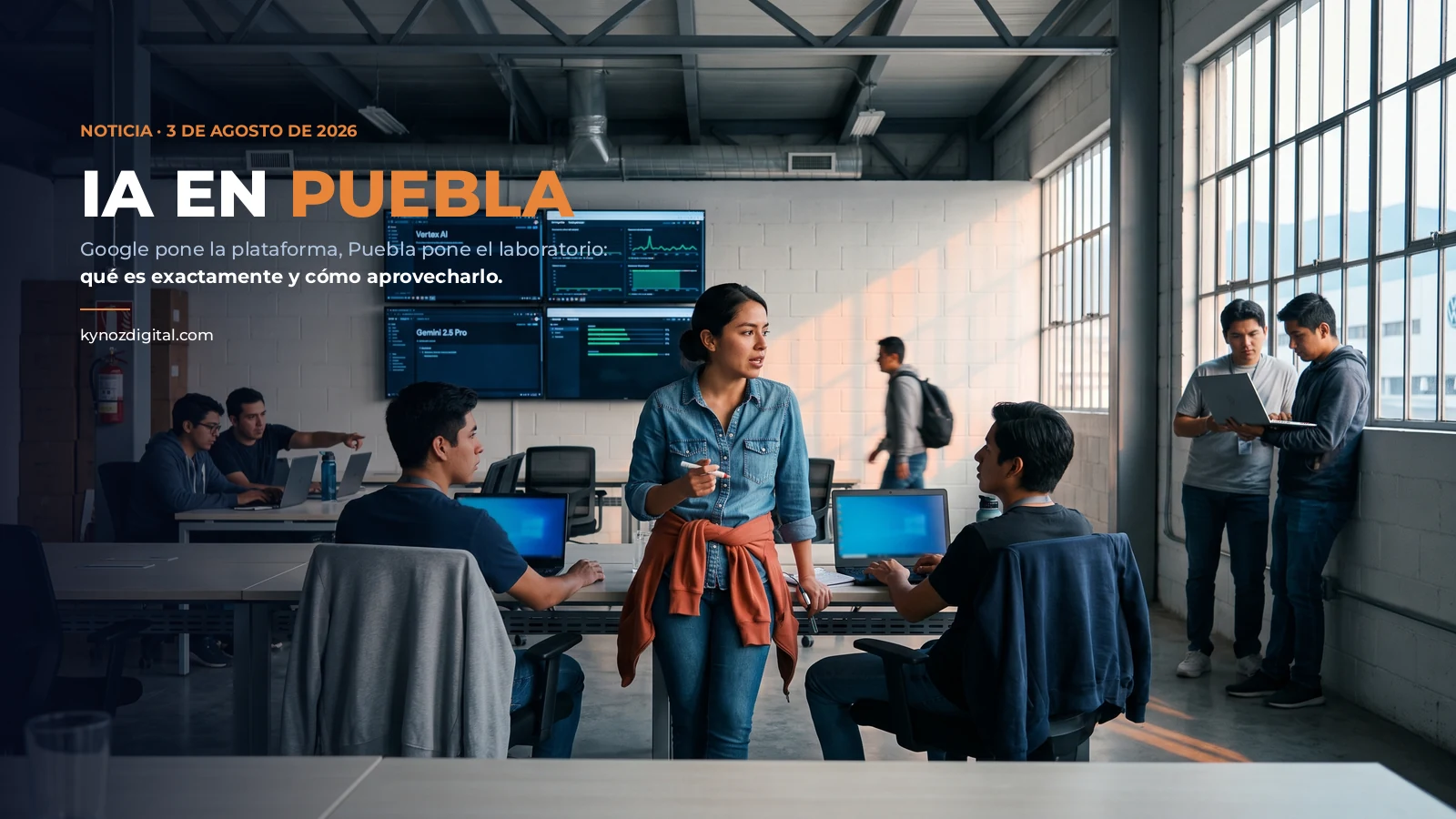
If you buy software development from Mexico — or you are deciding whether to — a headline out of Puebla is worth three minutes this week: the state is getting what the press presents as the first laboratory in the country to carry Google's name, and the paperwork behind it says something useful about the region your vendor works from.
The honest way to picture the project is a public gym. The state government puts up the building and pays for the equipment; the machines carry the most recognized brand in the business; and the results will depend, as they always do, on who shows up to train. None of that diminishes the thing — a serious public gym changes a neighborhood. It does mean the ribbon-cutting and the first workout are separate events, and that a reader in Chicago or Toronto is better served by the tender file than by the headline.
This piece is both: the good news, and the owner's manual.
What exactly was announced — and when?
The story carries two dates, and separating them clears up most of the confusion already in circulation.
The earlier date is April 20. Governor Alejandro Armenta announced that an artificial-intelligence laboratory tied to Google would land in Puebla, and that day's coverage placed it in San José Chiapa, inside CERHAN — the state's advanced technical-training center built beside Audi's plant (Milenio and Tribuna Noticias, April 20, 2026).
The later date is what filled Mexican portals on July 30 and 31, and it is the one that turns an announcement into a project with paperwork: the state government published a national public tender to refit a building, install the technology infrastructure and equip the laboratory (Publimetro, 24 Horas Puebla, checked August 1, 2026). That coverage presents it as "Google's first AI laboratory in Mexico," and the documents — as the portals report them — no longer point to San José Chiapa: they place the site in an industrial building in Cuautlancingo, inside the FINSA I park in the Volkswagen zone, sharing the facility with CERHAN. The new laboratory, the coverage notes, complements the original center.
One service note: outlets disagree on details as small as the street number on Avenida Roble. Until the state publishes a definitive address, "FINSA I industrial park, Cuautlancingo" is the version that will not need correcting.
Is this a Google lab or a state of Puebla lab?
It has some of each, and the proportions are the useful part.
What is published, in documents anyone can consult, is this: the tender is issued by the state government; the building where the lab will operate is state property; and Google's platforms enter the project as annual subscription licenses contracted inside that same tender. On Google's own press channels we could not find, as of August 1, an announcement of its own about this laboratory.
None of that shrinks the news — public projects of this kind are structured exactly this way. It does replace the wrong mental model with the right one. This is not Google opening an engineering office in Puebla, and nobody's vendor just became a Google subsidiary; it is a state government building a public AI facility on Google's stack, with its own money and its own procurement rules. The practical consequence follows: whenever access is defined, it will run through public channels — calls for enrollment, state programs — rather than a corporate sales counter.
Read as a signal, the mechanics arguably flatter the project. A government choosing to pay for enterprise-grade platforms, instead of improvising something symbolic, is committing to the expensive version of the idea.
The hard facts, in one table
| The question | What's published |
|---|---|
| What it is | An artificial-intelligence laboratory led by the government of the state of Puebla, running Google platforms; coverage presents it as the first of its kind in Mexico |
| The instrument | National public tender GEP-SPFA-LPN-197-603/2026: a single integrated service covering the building refit, the technology infrastructure and the equipment |
| The site | A state-owned industrial building on Av. Roble, Volkswagen zone, FINSA I industrial park, Sanctorum, Cuautlancingo — sharing the site with CERHAN (outlets differ on the street number: 16 vs. 17) |
| Hardware | 42 laptop computers running ChromeOS, with Intel Core i7 processors |
| Platforms | Annual subscription licenses for Google Gemini Enterprise Plus and Google Cloud Vertex AI |
| Timeline | Tender award: from August 21, 2026 · installation from late August · service concluded before the close of 2026 (coverage differs between "before December" and "by December 31") |
| Original announcement | Governor Alejandro Armenta, coverage of April 20, 2026 — with San José Chiapa named as the site at the time |
| Stated goals | Training for residents and specialized personnel, development of generative-AI solutions, support for innovation projects; complements the CERHAN in San José Chiapa, where Audi's technicians train |
| Investment amount | Not published as of this edition; none of the sources we reviewed reports it |
Sources: Publimetro, 24 Horas Puebla, Milenio, Tribuna Noticias and Telediario. All checked August 1, 2026.
What are Vertex AI and Gemini Enterprise Plus — and why does it matter that there are two?
Because they are not one product under two names, and the difference describes the project's ambition better than any adjective could.
Gemini Enterprise Plus is the organizational edition of Google's AI assistant: the tool a workforce uses day to day, with the administration and controls that the free app on a phone does not carry, even though the two share a name.
Vertex AI is a different category altogether — Google Cloud's platform for building: training and deploying models, standing up agents, running serious data work. It is the layer complete systems get developed on, and it takes considerably more than an afternoon to learn.
A tender that licenses both allows a practical reading — ours, not the tender's: the plan is not limited to teaching people to use AI; it contemplates forming people who can build with it. For a region's labor market, the second half is the part that leaves a mark.
What does a public AI lab signal to a nearshore buyer?
Start with where they chose to put it. Not a university campus, not a government office park: an industrial building in the zone that carries Volkswagen's name, sharing its roof with the CERHAN that complements the original training center in San José Chiapa — the one that raises high-level technical talent beside Audi's plant. Puebla's export economy grew up around automakers and their standards, and the state just placed its AI investment on that exact ground — infrastructure aimed at the industrial base that already pays the region's bills.
For a buyer in the US or Canada, the relevant question about any nearshore destination is less today's headcount than whether the place keeps producing the people your vendor hires next. A public facility training residents and specialists on Vertex AI and Gemini Enterprise — the same commercial platforms that teams like ours already build on — moves that answer in the right direction. It also does one quieter thing: it standardizes vocabulary. Projects start faster when the client, the vendor and the new hire mean the same thing by "agent," "model" and "deployment," and shared platforms are how that happens. All of it inside a workday that overlaps yours, which is the part of nearshore that never stops mattering.
Two cautions keep the signal honest. This is one lab, licensed a year at a time, with its access rules still unpublished — a data point on a trend, not the trend itself. And nothing in the tender file supports the sentence "Google moved to Puebla," so if that sentence ever reaches you in a sales deck, you now hold the accurate version. That precision costs us nothing to hand over: the case for this region was solid before this announcement and does not need inflating — we laid it out, numbers and sources included, in our standing piece on Puebla as a nearshore base.
Where does Kynoz stand in this?
Kynoz is a Puebla firm, and these platforms are not theoretical to us: software we ship for clients leans, daily, on the same AI tooling that lab will license. This article is written from that seat — current projects, not a demo environment.
Which obliges us to two plain statements. Google does not pay us and we do not resell its products; nothing here is a platform recommendation. And no platform, this one or any other, produces results on its own — it returns whatever the process underneath it deserves. We watch that every week, and it is why this text leans on use rather than brand.
What has not been published yet
The contract amount. The access mechanics — who gets in, under what requirements, at what cost. Who operates the lab day to day. None of it appears here until it is public; when it is, this page gets updated.
We're rooting for this one
The first mental draft of this piece was pure celebration, and we will not pretend otherwise: this is our city, and Mexico's AI map running through Puebla is good for us in every sense. The magnifying glass is not there to cool the news down. It is there because you are reading from another country, and the version of good news that survives scrutiny is the only version worth exporting.
---
The gym will open, and the machines will be first-rate. What no tender can procure is what Puebla does with it: that part gets decided in the companies, classrooms and teams that actually train. Filed precisely, the news is smaller than the headline and better than it — not a Google campus, but a state spending its own money on the skills your vendor will be hiring for years to come.
If one process — yours, or your Mexican team's — is the one you would hold up against these platforms first, put it in front of us through the contact form or on WhatsApp. Deciding where AI pays and where it does not, process by process, is what our week is made of.
Frequently asked questions
What is the Google AI lab in Puebla, Mexico?
A public artificial-intelligence laboratory led by the government of the state of Puebla, operating on Google platforms (Gemini Enterprise Plus and Vertex AI), which coverage presents as the first of its kind in Mexico. It is being contracted through a national public tender covering the building refit, the technology installation and the equipment; its declared goals run from training residents and specialists to developing generative-AI solutions.
Where exactly will it be?
In a state-owned industrial building on Avenida Roble, in the Volkswagen zone of the FINSA I industrial park, Sanctorum, Cuautlancingo, sharing the site with CERHAN, the state's advanced technical-training center. Outlets differ on the exact street number, and the original April announcement named San José Chiapa as the site — treat the fine-grained address as preliminary until the state publishes a definitive one.
When does it open?
The published calendar puts the tender award from August 21, 2026 onward, installation from late August, and the service concluded before the close of the year — coverage differs between "before December" and "by December 31." An opening date for the public, and the rules for getting in, have not been published.
Who is paying for it — Google or the government?
What is published is a state government tender, on a building the state itself owns, with Google's platforms entering as annual licenses contracted inside that tender. The contract amount is not published, which is why you will not find it in this article. As of August 1, 2026, we found no announcement of the laboratory on Google's own press channels; if that changes, this page gets updated.
What are Gemini Enterprise Plus and Vertex AI?
Two Google platforms with different jobs. Gemini Enterprise Plus is the organization-grade edition of the Gemini assistant, with administrative controls — not the free consumer app, though they share a name. Vertex AI is Google Cloud's platform for building AI systems: training and deploying models, creating agents, working with data. In short: one is for using AI at work; the other is for developing systems with it.
Does this change anything for a company evaluating Mexico for nearshore development?
Not by tomorrow morning. What it adds is evidence about direction: a state government spending its own budget on AI training capacity, placed in the industrial zone where its export economy already operates, on the same commercial platforms that teams like ours already build on. Two things are worth watching from abroad: the tender award on August 21, 2026, and the access mechanics when they publish. And if a pitch ever inflates this into "Google's new Puebla offices," you have the factual version in the table above.